The method
Score facts, not feelings
The full reading takes about thirty minutes the first time. Before you run it, there is a contradiction worth naming, because the book names it rather than hiding it.
The contradiction
The book spends nineteen chapters arguing that your sense of your own situation is unreliable. Apps say green while structure fails. The bank balance rises while spending drifts up. You feel fine while sleep timing slides.
Then the same book asks you to score yourself across fifteen levers.
The contradiction is real. Worth naming. The answer is in how the questions are written.
The rule
The questions do not ask how you feel. They ask whether something specific is true.
Are your weekday and weekend wake times within sixty minutes of each other, yes or no. Can you say how many months your accessible cash would cover at your current burn rate. Did the focus blocks you scheduled this week actually run to completion.
None of those is a judgment about yourself. Each is a fact you can check.
The uncertainty rule
If the answer is "I am not sure"
That is not an 80. It is closer to a 50.
A system you cannot read is a system that is not running the way a stable one runs.
This bites hardest on the money levers, where being unsure about a number you could compute in twenty minutes is itself the finding. It tells you exactly which twenty minutes to spend next.
Your first score will be too high
Almost every first score is. Score it anyway.
The point of the first score is not precision. It is to find which lever sits the lowest, and that answer survives a fifteen-point error. A lever you scored at 70 that should have been 55 is still the lowest lever on the page.
Score again in four weeks. The trend is the real instrument, not the first reading.
What the reading gives you
The nineteen chapters before the closing one are the diagnostic tool. Each teaches you to see a failure point that was previously hidden, or a target condition that had no name when you opened the book. Together they give you a structural map of your own life that did not exist before.
The reading produces the number. What you do with it is the part no instrument can decide.
Two ways to run it
By hand. A free one-page worksheet collects all fifteen levers, their diagnostic questions, and the scoring in one place. One page, no app required. The book is explicit that this is enough: the manual reading is sufficient to see where the structure is failing.
Continuously. FREE60 runs the same framework from signals already living in your health data, calendar, and financial systems. It does not replace the book. It automates the reading the book taught you to make, so the fifteen levers stay measured together without rebuilding the diagnostic by hand each week.
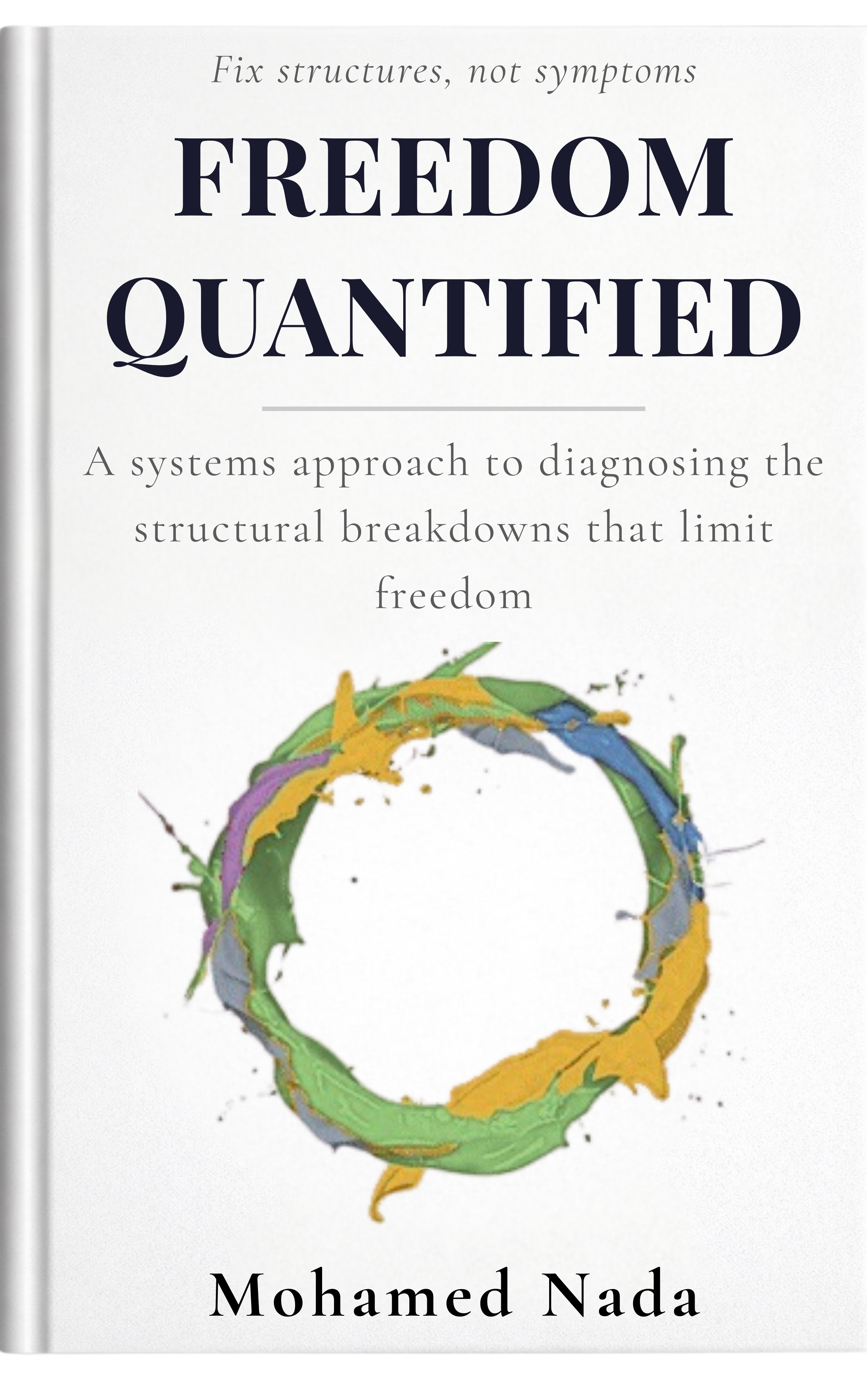
Freedom Quantified
The diagnostic questions live inside each chapter. Chapter 20 collects them into a single reading.
Get the book on AmazonOr start with the free one-page worksheet.