The framework in the book
Three domains. Fifteen levers. One reading.
Three failures running at once, three separate explanations, and no language for what connected them. That is the structure most people cannot see: separate problems, each with its own excuse, all talking to each other in a vocabulary nobody has.
The premise
Three places exist where life fails structurally. Body. Money. Operational capacity.
No amount of money fixes a body that is not recovering. No amount of fitness fixes a financial structure that cannot absorb a shock. No amount of planning fixes a week with no margin to execute it.
Fix one while the other two degrade, and the fix mechanically unwinds. Leave all three unwatched, and the person standing in the middle of them wonders why everything feels harder than it should.
Body first
When physical systems fail, restoration does not finish. Strain builds faster than recovery can clear it. Baseline capacity drops. Nothing else runs cleanly. You cannot think your way around a body that is not recovering. You cannot negotiate with it. You cannot compensate with effort.
Bedtime slides by ninety minutes four nights in a row. You are still fine in meetings. At home you are short with people who did nothing wrong. A minor strain that used to resolve in a week is still there on day twelve. Spreadsheets and calendars look under control while the floor is missing.
Money second
When financial structure fails, spending outpaces what you can sustain. Buffers erode. Income becomes fragile. Money pressure does not stay in its lane. It forces bad decisions in every other domain, narrows career options, shortens the planning horizon, and fills your head with arithmetic at 2 AM.
A buffer that used to cover six months now covers six weeks. You take work you would have refused eighteen months ago. You defer maintenance on everything that does not scream. You argue about small purchases because the margin for error vanished one auto-renewal and one lifestyle upgrade at a time.
Operational capacity third
When attention and schedule fail together, focus breaks apart. Commitments multiply without review. Time flows to reactive defaults instead of stated priorities. Routines that held the week together dissolve. You have the intention. You cannot convert it into consistent, structured action.
Calendars go full color. One project that actually mattered gets ninety minutes in three weeks. Email gets fast replies. The hard document does not move. People experience you as responsive. Inside, you are running calculations about whether this week counted as real work.
Isolated fixes unravel for exactly this reason. You repair one lever while another pulls the system down from the other side. Reading still starts with the body, because load and recovery sit upstream of judgment.
The fifteen levers
Five per domain. Each lever detects one or more independent failure modes. Each failure mode produces a signal. Together they produce a reading. One chapter of the book per lever.
Physical capacity
- Sleep. Whether recovery starts on schedule, runs to completion, and ends on schedule. Timing, not just hours.
- Load. Whether strain is clearing faster than it accumulates, counted across every source rather than training alone.
- Activity. Distribution across the week. Nothing piling up on Saturday, nothing crashing on Wednesday because the previous five days were spent sitting.
- Nutrition. Whether the body gets enough protein to repair what it uses each day, set up once as a kitchen default rather than a daily decision.
- Care. The clinical pipeline that catches what the other four cannot see. Preventive checkups current, no referral forgotten in a drawer, no blood test overdue.
Financial capacity
- Expenses. Whether monthly spending stays inside a range you set, measured on the moving total rather than on categories.
- Liquidity. How many months accessible savings cover at your actual monthly spend. A number calculated, not estimated.
- Income. Whether inflow comes from more than one source, and who is able to close each one.
- Investments. Whether surplus is deployed on a schedule without requiring a decision each month.
- Risk. The structure that determines whether the other four survive something unexpected. Concentration above 40 percent in a single position is where it starts.
Operational capacity
- Focus. Whether attention holds long enough to finish work that requires sustained thought, or arrives already broken into pieces too small to reassemble.
- Priorities. Whether the commitment list is shorter than what can actually be advanced in a week.
- Schedule. Whether time flows toward what you said mattered, or toward whatever demanded the most attention in the moment.
- Buffer. Whether the week has enough space to absorb one normal disruption without breaking.
- Routine. Whether the recurring structure that held the week together is still running, or dissolved after a disruption and never came back.
What the levers measure, taken together, is the room a person has before structural pressure starts forcing decisions. Body, money, capacity, all mechanical. None of it a feeling.
What the levers produce
Scores build from the bottom. Lever scores combine into domain scores. Domain scores combine into one number, the Freedom Index. At every level, the weakest component stays visible, because a system that lets strong areas hide weak ones produces exactly the illusion this book is about.
The Freedom Index
How the number is built, what 82 and 60 and 45 actually mean, and the four things the reading deliberately does not measure.
THE BOUNDARYWhat it excludes
Relationships, happiness, purpose, motivation, discipline, and productivity are all left out on purpose. The reasons matter more than the list.
THE METHODHow to score yourself
Score facts, not feelings. Why your first reading will be too high, and why that does not matter.
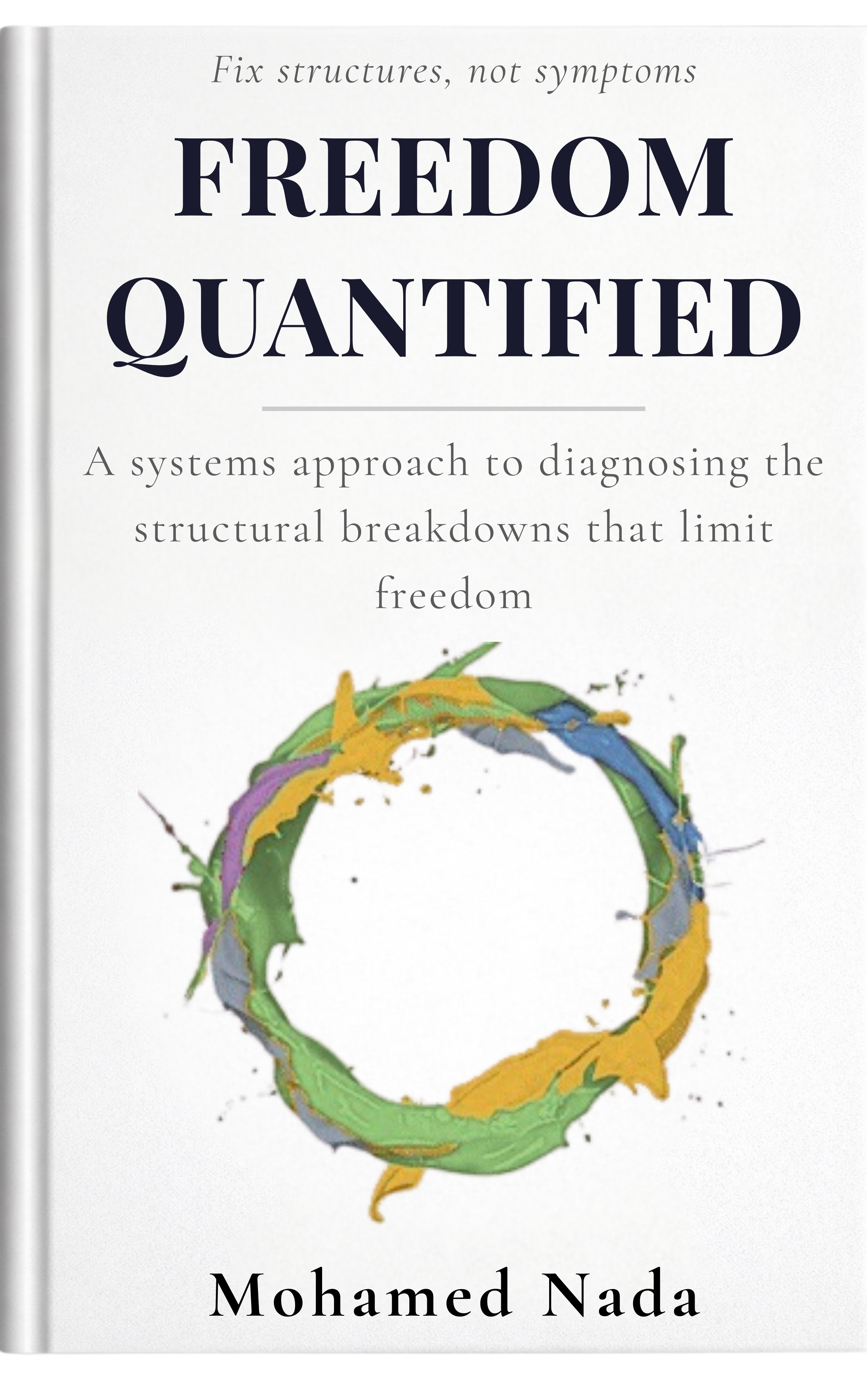
Freedom Quantified
Twenty chapters. One per lever, plus the foundation that explains why the instruments you already own cannot see any of this.
Get the book on AmazonThe framework runs on paper. A free one-page worksheet covers all fifteen levers.